
MEMBER SPOTLIGHT
Trish Powell, CJF
(Originally published in the AFA No Foot, No Horse)
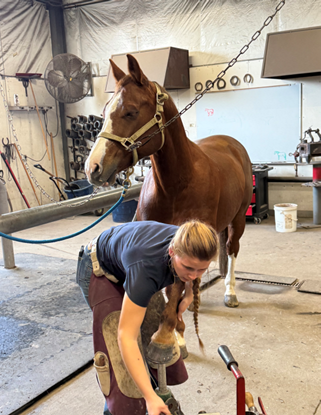
I began my farriery journey when I was fresh out of high school and went to Troy Price Horseshoeing School in 2021. I had asked any farrier I knew if I could apprentice, either before or after school, and every single one of them told me no. So, with nothing, but the idea that I liked horses and wanted to help them, I started my 36-week farrier course that was offered by Troy. I had heard the word “certified” probably a dozen times by week two, with no one going into further detail about what that even was.
I had thought that there wasn’t a test for farriers because they were not regulated. Finally, one of the girls I was close to had told me that the American Farrier’s Association held a voluntary certification program. I wasn’t so interested then as I was more focused on learning not to cut myself with the knives and rasps.
After about 25 weeks in school, another student had started to make a mock shoe board. Troy asked if I wanted to participate in the certification program and I said “sure.” Of course, this was only about one week out from a certification in Ohio, so it was a lot of late nights and early mornings trying to get our shoe boards finished. At the certification test in Ohio, I passed my written and my shoe board.
When I got to my horse, they informed us that we would need different work stations and tools, but we had only brought enough for one station. I tried to find a different station, since the other student seemed much more invested in the certification program than I was. I was so nervous, I barely trimmed the feet flat enough to move forward, and I ended up picking a shoe that was far too small for the horse I drew. I walked away pretty defeated, and I decided now I had to someday finish.
About three weeks after I finished school, I went to a Kentucky Certification and passed the horse. Well, I was now a Certified Farrier. I went to the Michigan Contest about three weeks after my certification. I met a lot of farriers from around me and even some farriers that used to do my horses. I talked my old farrier, Dan Mast, CF, into letting me work with him sometime. I started shoeing three to four times a week with Dan as I also grew my own business as well.
Eventually, Henry Detweiler, CJF, had taken notice and also asked me to work for him. One day, we were in the truck driving to our next stop when Henry turned to me and asked me, “Would you move to Iowa?” I really didn’t know what to say. Henry explained that Doug Russo, CJF, AWCF, the Resident Farrier at Iowa State University, was looking for a new apprentice, and Henry had given him my name.
I spoke to Doug about the job at the next Michigan Contest, and he told me to come on out and work with him for a few days. So, for my 21st birthday, I drove out to Iowa and worked with Doug. I had been working with Henry and Dan so much that I had not been practicing forging skills, only shaping shoes to feet, so there was much that Doug had to school me on. I tried to do it how he said and my shoes kept improving every time. Doug told me if I wanted the job, I could move out there, as he wanted someone who was willing to learn and improve.
I moved out to Iowa in April of 2023. At Iowa State, Doug and I work on a lot of lame, stubborn and neglected horses. It was a huge learning curve, going from Amish Standardbreds to navicular Quarter Horses. We also teach 4th year veterinary students in a two-week farrier rotation. We go over topics such as navicular, as well as other pathologies, anatomy of the distal limb, and even pulling shoes safely and forging. I am extremely blessed in this sense because honestly, if you can teach it, you know it, and you have to understand it and go over it countess times.
In the late summer of 2023, Doug told me, “I think you’re ready to be a Journeyman.” I was very surprised when he said this because I had just gotten to the point where I could clench nicely. One of the best parts about working with a legend, is you can get a demonstration whenever you are feeling stuck which unfortunately for Doug, happened about every day of me trying to figure out how to make a bar shoe. In the mornings at work, Doug would work with the vet students on various topics, pathologies, etc.
So, in the mornings, I would be making bar shoe after bar shoe. At first, it was all about making them not look like they were drawn by a 6-year-old, but eventually I was putting the hoof shape into them. After I relearned how to use a fuller, again, they were coming out consistently with a potential passing bar shoe.
Then, the timer. Doug told me I was going to have to start speeding up so I could do it in less than an hour. Doug gave a demo about how each heat is for one or two steps of the bar shoe. I started to count heats until I could make the shoe in about 12 to 14 heats. Twelve heats were about 30 minutes and if I could get a shoe done in that time, that gave me five minutes for rasping and maybe fitting if it didn’t already fit to the template.
I started to make, as Doug would call them, “crackers” each time. I gained confidence about where I was going with each heat and where I could be more ready for the next heat.
I went to my first Journeyman Certification in September 2023, passing my written and failing my bar shoe by a point. The next day was the horse, and when Henry pulled it out, I almost started laughing. It was a Standardbred mare that probably wore size 5 on the front and size 4 on the hind. This was my practice. I had not even shod a horse with plain stamps since school.
When working at the college, every horse we would receive hospital plates, fishtail bar shoes, heart bars, or patten bars. We always fuller so that we can easily take them off with creased nail pullers because of how painful or foot sore the horse usually comes to us. I took a deep breath, grabbed some of Henry’s 3/8 by 1 and 3/8 by 7/8, and the time started. I did not think I could get this horse done in time, but I knew it would be great practice, no matter the outcome. I finished that horse in time and failed by rasping off some clinches. I was disappointed but understood that I probably wouldn’t pass the first time.
A month later, I went to a Certification in Indiana. I passed my bar shoe with flying colors! The next morning was the horse. The unfortunate thing about working for an Examiner is that they cannot help you on exam day; instead, they are there to view your work as by the book and make sure the Testers’ scores are accurate. This scared me quite a bit. I was nervous and unfocused, and I did not fit the feet at all and failed for a second time.
In the Spring of 2024, I started shoeing Doug’s personal horses and some hospital teaching horses that could have plain stamps on. The next Certification I went to was Iowa’s in April. I finished the horse, but my finish score was points away from passing. I tried multiple other certifications after this and at all of them, I was always nervous and very anxious before I took each practical. Even Testers that had watched me since the beginning, had told me I needed to calm myself. I also had not been able to practice as much as I would have liked to have done.
At Iowa’s Certification in April 2025, I set up my station for my practical exam. My Examiner was Eric Gilliland, CJF, TE, FE and my Testers were Heather Beauchemin, CJF, TE, AWCF, and Tobias Ellis, CJF. Heather reminded me to stay calm, collected, and focused. The Testers and I talked about the feet as they were on the short side and so I would have to be conservative on my trim. When the timer started, I had my precut steel and marked them, and then the steel for the fronts were thrown in the forge. I trimmed the fronts first as I can shape hind shoes a lot faster than front shoes. I started trimming hinds and making hind shoes as the Testers scored my fronts. I don’t make three heat shoes because I end up messing up exactly where I want my nails to go. I always take the extra heat for good nails. I nailed fronts on as the hinds were being scored. I clenched the last nail and had a couple minutes to spare. I decided to sand them a little and leave them as rasping off clenches hurt me before. Many horses were being judged at the same time and it had been over an hour waiting for my result.
I found my Testers and Examiner speaking, and assumed it was about me, so I moved closer to them hoping to hear. Eric took pity on me and asked the Testers, “Can you go ahead and tell this poor girl her results?” The Testers looked at each other, smiled and then smiled at me. I am a Journeyman!
After all was said and done, I felt about 50 pounds lighter than when I had arrived. Getting the horse done was so built up in mind that it was just impossible, and I had just done it. It is amazing what you can accomplish when you stop thinking everything is going to go wrong. But the funny thing is, everything did go wrong, but I had taken the test enough to know how to fix it. My steel was short, I had to stretch. My steel got burnt, I had to spend more time cleaning. I rasped a clench off, I had to put a new nail in. I was scared, but I got it done.
My biggest advice is to stay calm. You obviously have some idea what you are doing. You came to certification for a reason, so put your head down and get your work done. Secondly, take the advice from everyone around you. They know what they are talking about. And lastly, work on your problem areas. I work in an environment where there is lots of time to forge and study with the vet students, but not so much time with horses that aren’t lame. I had to make time to work on doing horse so that I could pass. I am super thankful to everyone who helped me learn and grow and the farriers that let me ride in their truck to have a Journeyman go on their clients’ horses.
I want to thank Doug Russo for being an educator in every sense of the word. I had watched him work with vet students, farrier students, and even educate top farriers in this industry. Doug is one of the rare people who will put educating the new generation before anything. I also want to thank Dan Mast and Henry Detweiler for believing in me and teaching me as well. I also want to thank the amazing Examiners and Testers who sacrifice their weekends just to work with up-and-coming farriers. I am sincerely honored that I was asked to share my story and thank you for taking the time to read. Best of luck to the future Journeyman reading this article and I hope it will come to help someone on their journey.